Yesterday, I was talking with my mom about the iterative nature of design thinking. This made me think about the places other than MSTU 4029 that I use processes of iterative improvements. Here are some examples of places where, without even thinking about them as iterative improvements, this process has come naturally.
- I tried this vegan mushroom stroganoff recipe for the first time a few week ago. First try – too watery. Second try – less water and more cashew butter for better sauce consistency, but overcooked pasta. Third try – heartier pasta and pretty darn good.
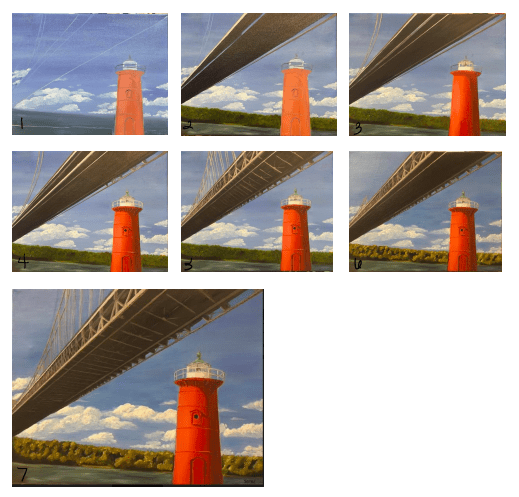
- I paint as a hobby. When painting, you constantly evaluate the work and make decisions about what to do next. Sometimes what to do next is work on a new section or make small changes to something. Sometimes it’s to paint over something that doesn’t meet your goals and try again after the paint dries. This particular painting is a key example having to revisit and improve. After week 5, I realized that the angles on the bridge were all wrong and had to paint them over and try again. In other cases, incremental changes like darkening shadows or brightening clouds were enough.
- I write a fair number of HTML templates for sending emails to alumni, prospective students or subscribers to Klingbrief. Since various email systems read HTML and CSS differently, each email sent involves numerous test sends, which are then viewed in multiple email programs on different devices. Each is reviewed carefully, the design is tweaked and another test sent – over and over until the result meets expectations.
I like to be able to illustrate with examples when explaining a concept. So while these three examples are not design thinking, they are examples of trying something, testing it, revising, and testing again. In helping others think about design thinking, these daily or mundane examples of iteration might help demystify the idea of prototyping and testing. Other examples could be anything from choosing an outfit in the morning (switching pieces until happy with the overall look) or building a tower of blocks with your niece (adding and moving pieces, or knocking it all over and staring again, until you have the desired creation).
Think about your own life. Where do you iterate toward better processes or products day-to-day? Share in the comments if you have examples to contribute. For now, I have a rather tricky painting of a fountain to go work on…
 technology has some haters, I have been using it for the last 22 years and can’t fathom not having it. I love that it lives in the middle of my keyboard and that I don’t have to move my hands to a trackpad in order to use the mouse features. I love that I don’t accidentally tap it with my wrist and move my cursor when I don’t mean to like I do with trackpads. I’ve even had desktop keyboards with the red dot because I find it so efficient to use. I love the dot mouse and I really don’t want a laptop that only has a trackpad.
 Second, my X230 is pen-enabled. I don’t need a wacom tablet for graphic design. I can hand write notes directly into my laptop when typing is either too distracting for the setting or requires diagrams or drawings. When I was teaching, OneNote was my whiteboard in class and my pen-enabled laptop let me easily annotate students’ code to more easily answer questions and correct assignments. While its not a feature I use every day, I’d sorely miss the pen feature if I didn’t have it.
 Jessica Sepke